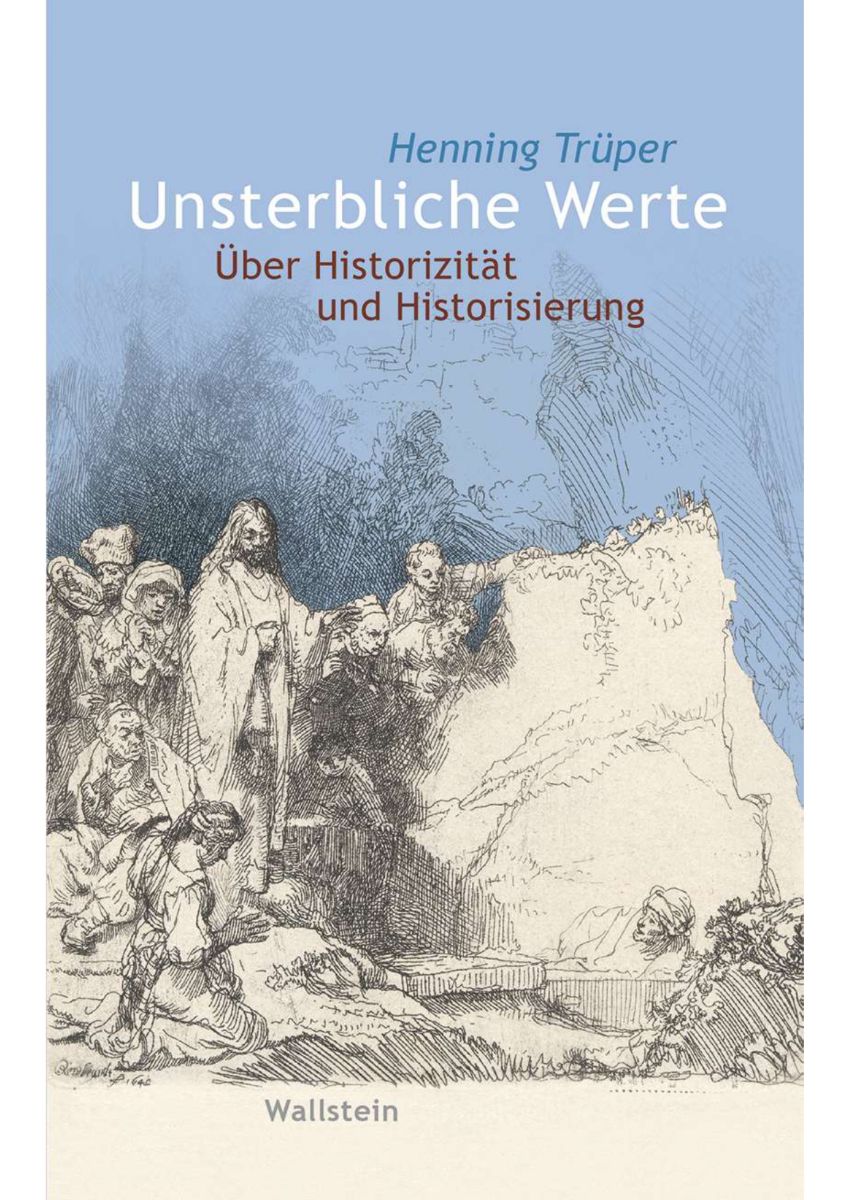
This book is about history in terms of values and norms: fluid values and lasting values, immortal values and values that are consumed and disappear. The book explains the difference between history and the past. Its two key concepts are historicity and historicization. It provides examples from a long period of time.
Conversation with the author
Henning Trüper is associate professor of the history of ideas at the University of Oslo. After his PhD at EUI, Florence, he held postdoctoral and research positions in Zurich, Paris, Princeton, Berlin, and Helsinki. From 2020-2025 he led the ERC CoG project “Archipelagic Imperatives: Shipwreck and Lifesaving in European Societies since 1800” at Leibniz Center for Literary and Cultural Research (ZfL), Berlin. Publications: Topography of a Method: François Louis Ganshof and the Writing of History (Tübingen, 2014); Orientalism, Philology, and the Illegibility of the Modern World (London, 2020); Seuchenjahr (Berlin, 2021); Unsterbliche Werte: Über Historizität und Historisierung (Göttingen, 2024).

BS Your book is enormously erudite, permeated with profound reasoning and references to a long row of scholars from ancient Greece via medieval thinkers towards modern philosophers like Leibniz. You bring Kant, Nietzsche, and Benjamin into the center stage. You delve into the depths with numerous examples. I wouldn’t say it’s a quick read, or even an easy read, but if one puts in the effort, it is a source of rich intellectual experiences. It is beyond my capacity to go into a detailed discussion with you at the level of your sources, but I would very much like to talk with you about the larger lines that your details provide.
We can perhaps start out from the fact that the past from the beginning of human existence on earth is endless like the universe, an endless and chaotic mass of facts, events, processes, interactions, inclusions and exclusions of humans. This is where history comes in. History is the attempt to order this chaotic mass and give it meaning by dividing it into periods and spaces, peoples and classes, and many other categories. Against this backdrop your question is about history. What is it as distinguished from the past? How has it been told, written, produced, and constructed? Your two key concepts are historicity and historicization. They are not just easily defined analytical instruments but entangled with values and morals. One of your overall ambitions is to explore the connections between historicity, morality, and value. The book’s title talks about immortal values.
I would like to begin with a question about the distinction between historicity and historicization. And what do immortal values mean in this connection?
HT First of all, thanks for reading the book and for taking an interest in it! You do start out with very big issues, right away, of course. I would say that the book is an exploration of the meaning of “historicity” from a point of view that does not take for granted the idea that the writing of history is primarily about “knowledge” and that its conceptualization should be done in epistemological terms. Rather, I wanted to address historicity as the quality of a strange, discursive object, as a reality that one can describe, provisionally, as standing in a relation to past reality that is selective in some way. History is a sort of miniaturization of the past, to use a metaphor Giorgio Agamben once brought up. Miniaturization is at least as much about matters of value, however, as it is about matters of knowledge. I wanted to discuss history in terms of values, and in terms of norms. And as a consequence of the peculiar ideas about these two terms I ended up developing, over the course of writing the book, I ended up with a differentiation where historicization is about the fleeting values vested in the pursuit of “the historical”, whereas historicity is about bounded, stabilized, and repetitive values, which take on the form of norms. Those are the “immortal values” of the title. The basic idea is that “the historical,” when seen from this angle, implies two concepts, not one. This may appear to be a strange point; but I do think it resolves a lot of problems and blockages in the philosophical understanding of history.
BS To bring order into the past, making history of it, sounds like a holistic ambition, to discern one holistic world history, one huge nexus of causes and effects, but this is not your approach. There are beliefs in goals in history, but history has not a telos. You have in a previous book confronted the idea of history as teleology, as progress towards a final goal. The building stones in history are facts, but, as you emphasize, this doesn’t mean that you make or construct history by adding facts to facts like a bricklayer building houses. You select the facts but not by random chance. Why are some facts historical and others not? Do the facts have values? Or is it the selection of facts that have values? Who makes history? The actors in the historical narrative or the writers of the history, the historiographers? How do you grasp the normative dimension of the past? These might seem either banal, too abstract, or too huge questions but in a time which drives the public debate with arguments about alternative facts and false truths it is important to be clear about what history is being built and who the builders are before arguments about false or alternative histories block the debate.
HT I believe history’s normativity has a great deal in common with the norms vested into the care for the dead. It is a funerary practice that, confusingly, also stands in competition to the more concrete forms of processing the dead that subsist in societies. The care for the dead, of course, is a practice of the living, one that has to do with the sustenance of collectives over the replacement of their individual members. This is already something that pushes the assignment of value in the direction of permanence, of eternity. If life cannot be eternal, at least the afterlife is supposed to be, in most European and Mediterranean religious systems since antiquity. To be sure, the afterlife of being a cared-for dead person is itself rather impermanent. So there is a second death, that of being forgotten. Normativity has a lot to do with the futility of valuing. That futility in turn has a lot to do with history as a form of change. History is about the distinction of mortality and immortality, with the added problem that immortality does not make much sense outside of a set of discursive possibilities of speaking about the matter of dying, but also about the matter of value. In the nineteenth century, one can see the relative disappearance of positions that relate the writing of history to the creation of permanent remembrance – permanent afterlives – for the dead, simply because this kind of permanence appears to become implausible. But actually, it shifts shape and becomes translated into the problem of value, eternal value. Moral values, i.e. norms, are supposed to be eternal, and immortal. This also implies that they must have died first, in order to become immortalized.
BS You are looking for a philosophy of history, history as an epistemic system but something more than just confirming the world as it is/has become because it became as it became, a confirmative kind of history of the winners in a circular reasoning, where the alternatives disappear. Does history have a moral dimension? Can we learn from history in this respect? You have an emotional case that illustrates this question about the British fighter-bombers, which just a few days before the German surrender in May 1945, sank the German passenger ship Cap Arcona and the freighter Thielbek, loaded with thousands of concentration camp prisoners. The ships were mistakenly identified as troop transports. 7,000 people drowned and only a few prisoners survived. You talk about two of the shipwrecked in the icy Baltic Sea who desperately tried to stay afloat with the help of a board that couldn’t support both of them. One asked the other if he had a family, and when he got a yes for an answer, he let go, since he himself had lost his family. It was the survivor who told the story after the rescue. However, you find exactly this story in a text by Cicero in ancient Rome and ask whether the survivor could have known about it and to what extent it might have had impact on his story. Historical facts or morals from history, or both?
HT I use that story to make a rather specific point about the relation of (inter-)textuality and past reality. It is of course an episode where it is quite plausible that someone is trying to teach a lesson from history that can be recognized as a familiar moral one. I would not contest anyone’s right to try and use history in this fashion, as a trove of didactically useful examples, although I would also say that one can probably show for just about anyone who expresses a belief in teaching from history that in other situations they will be prone to admitting that it is not possible. “Historia magistra vitae” has never been more, I would contend, than a topos in a type of playful language game where the point is to answer with the contrary meaning. I think the moral significance of history is rather more subtle than that. History is a discourse and practice that supplies some of the terms and conditions in which we understand moral norms and values at all. For that reason I think that the philosophy of history has to be understood as part of practical rather than theoretical philosophy, although the latter position is very dominant in contemporary thought, at least.
BS When you talk about immortal, there is a tension between the humans as species and as individuals. As individuals some of them may become immortal through the historical narrative where they live on for new readers generation after generation. This was also the belief about the species until the concept of the human-made Anthropocene was introduced a few decades ago. The human species lived in the endless through reproduction, or at least to the apocalypse. I think this, too, is a question about immortality, historicity and historicization that we just talked about.
HT This is something I found exceedingly interesting to learn: In early modern Europe, it was not uncommon, when addressing the issue of immortality, to distinguish the immortality of species from the immortality of individuals (individual souls), and to claim that one could only have one of these immortalities at the expense of forgoing the other. So-called Averroists tended to believe that only the order of species was eternal, and that the creator-deity had only set down this order and nothing about the fortunes and fates of the individuals within the species. One could discount the immortality of the soul because only the species were immortal. Until the end of the eighteenth century, this was still a surprisingly popular way of undercutting Christian claims about salvation and the life eternal, and this matter relates to all other manner of political thought that has to do with Christianity and the opposition to it. Consequently, it was important to other thinkers to counter this way of describing the world; but that then meant that the order of species had to be regarded as transient, including, as already Leibniz states, humankind. Leibniz is clearly quite taken with the idea that humankind will die out and, it is to be hoped, be replaced by a species of higher intelligence. Yet the entire debate disappears in the nineteenth century. At first, people cannot see why only one of the two kinds of immortality should be obtainable; and then, they do not see how either individuals or species could ever have been regarded as immortal: obviously, they can both die out! This becomes the default, the reasonable position to hold, and no doubt most of us today would continue to subscribe to it. Yet, as mentioned, the underlying structure of the distribution of options regarding immortality becomes replicated in languages of value, even in the ambit of seemingly minor concepts such as “consolation,” as I try to show in the last chapter. In this way, the older thinking about immortality supplied a structure that became important for the way norms and values have been understood, in modern times.
BS When I think about historicity and immortality, I think of the fleeing family in Pompei who were caught by the lava, rediscovered during the excavations 1800 years later and immortalized in plaster. But where is the moral?
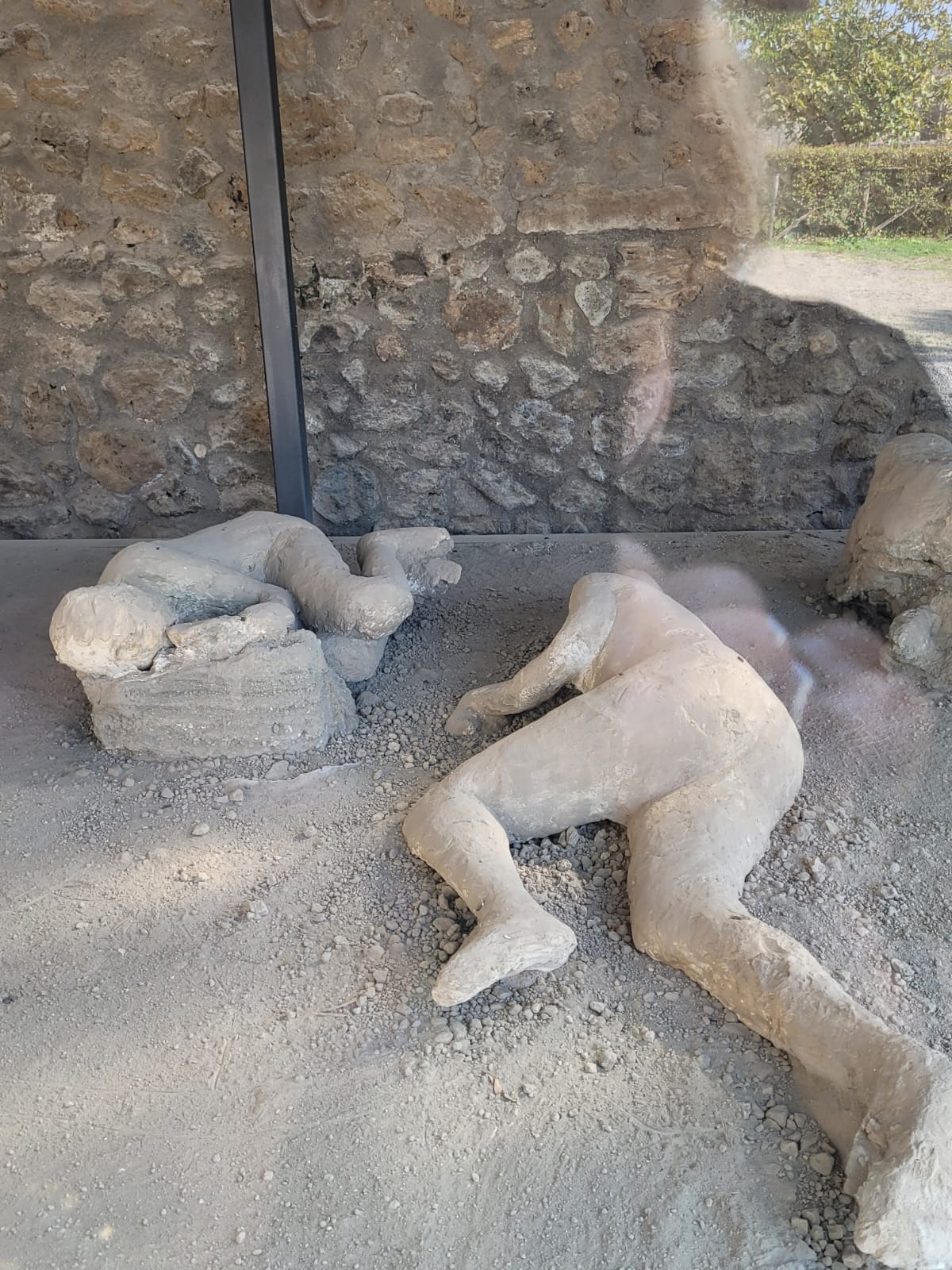
Immortal through archaeology. Pompeiji 79 and 2023. Photo: Bo Stråth
HT Sure, to use the example: The “fleeing family” are of course not simply remnants from a historical disaster, but the products of care, of a labor of excavation and a further labor of filling in the hollow forms in the ashes so that the shapes of these corpses could remain preserved without the matter that had enshrouded them since the disaster. It’s not the pyroclastic flow of Mount Vesuvius alone that made history. At the same time, it is perfectly conceivable, even probable, that human beings will stop caring for Pompei altogether – after all, for a very long time nobody cared about the place at all. In the meantime, there is a labor of historicization vested into the archaeological site. The care invested in those dead of Pompei, in this interval between onset and petering out, means that “we” – a rather non-descript collective of the living – make community with them. This community is affective, mimetic: one immediately starts to think about what it would be like to die in that manner, what these humans must have suffered, and so on. The capacity for this kind of empathizing also reflects back on the language of value, in which the ability to sustain value in seeming permanence – we do not like to think that it is just an interval – is a chief condition. This creates a double bind with the work of history: neither is possible without the other.
BS You write about the Russian cosmists where the nineteenth century philosopher Nikolay Fyodorov writes about humanity as a species and its endeavor to physical immortality through technical innovation. The nineteenth century had many ideas of progress, in particular technical progress, but how spread were such radical ideas? I feel a dimension of nihilism in the example. Was it a Russian phenomenon or was cosmism spread in Western Europe as well? The example looks like a historical visionary heralding the tech oligarch Peter Thiel. I didn’t know that he had such predecessors, and he might not know it himself who rather looks for the dark enlightenment in history.
HT As far as I understand this history – I’m far from feeling well-informed about it – cosmism was indeed a rather limited Russian phenomenon. But it is something that harks back to the thinking about immortality I mentioned earlier. Cosmism is a technological fiction about defeating not only individual mortality, but also species mortality, for humans. Some of the charm of this fiction is, of course, that it has points of touch with very present imaginations of technical omnipotence. One difference is, of course, that the “tech” visionaries of today typically just think of themselves; they seem to look at immortality as the ultimate form of social distinction. Fyodorov wanted to keep everyone alive, and he even insisted that the deaths of all humans that had already died would have to be reversed for immortality to be truly realized. So this idea of radical equality within the species marks his position as in some regards the direct opposite of what we are witnessing today. It is also worth noting that, historically, cosmism is not merely a Russian phenomenon, but one that has much to do with European traditions of thinking. After all, Fyodorov was an early and avid reader of Nietzsche’s. And Nietzsche, who is one of the protagonists of the book, is certainly one of the most influential figures when it comes to philosophizing about value in the twentieth century. Nihilism is indeed a good keyword here. The concept makes most sense, I think, when taken to mean a specific understanding of value, namely the denial of the permanent validity of any value. Cosmism, of course, had wanted to cancel the condition of value transiency that underpinned nihilism. The contemporary visionaries of immortality, on the contrary, believe in the fundamental value of them being alive. And just them, to boot, one should emphasize. They do not think – unlike what most of the many literary treatments of immortality at least in the twentieth century suggest – that immortality would be just another realization of nihilism, as it would take away the ability to value anything. Then again, neither did cosmism. In a sense, I wanted to include those historical perspectives in the book in order to show that present-day thought on these matters is often not up to par even with the universally reviled nineteenth century. There is a certain underlying failing of historical care, if you will. So in that way, the book is also itself an exercise in historical writing.
But what about nihilism, then? The stable validity of values, I would tend to agree with the more reasonable formulations of such positions, is at best a relative quality in comparison to other, even more transient values. This may mean that there are some values we may consider as being beyond any scenario of disappearance we can, at this point, imagine. Notions of the moral good seem to be of this kind. Yet, are they, for instance, truly independent of the existence of the human species, which is a contingent fact? Maybe we simply tend to trick ourselves, on account of the normativity of normativity, the norm that there ought to be norms (which seems to open a logical regress of norms). And in my view, this type of second-order norm coincides with the norm that there ought to be history, in some form or other. And again, will there always be history in a meaningful sense? Some theorists – Reinhart Koselleck comes to mind, but also François Hartog or Hans Ulrich Gumbrecht – have argued that already in the present, many of the conditions of the sustenance of history in western societies are being eroded. I do not fully agree with those arguments. But they are certainly an indicator for the fragility of the complex of norms and values that has emerged around the category of the historical.
BS It is fascinating to listen to you, Henning. Your book has much more of this. Thank you so much.
How to quote:
Cit. Bo Stråth, “Henning Trüper, Unsterbliche Werte. Über Historizität und Historisierung.” Blog. https://www.bostrath.com/planetary-perspectives/henning-truper-unsterbliche-werte/ Published 28.12.2025
Comments
Please submit you comments with the Contact Form or send an Email to bo.strath@gmail.com.